


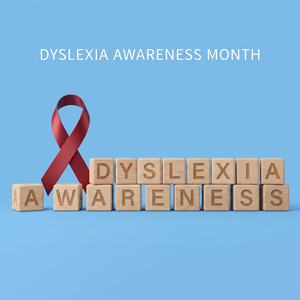
October is Dyslexia Awareness Month.
At some point you will talk to your child about their dyslexia, and a lot of us freeze. We don’t want to label them. We don’t want to scare them or make them feel different. So, we say nothing. We hope the love is enough, but it isn’t.
Unfortunately, the silence doesn’t protect them. It leaves them alone with the scariest version of their story which can do more damage than dyslexia ever will.
Let me name the thing most of us do without even realizing it, because I did it too. When we find out our child is dyslexic, a lot of us go quiet around our child. We think we’re protecting them. We don’t want to make them feel different or scared or singled out. We definitely don’t want to label them. So we tiptoe. We say things about everybody learning at their own pace. We never actually say the D-word.
But here’s the problem. Your child already knows something is different. They have known for a long time. They see that the kid next to them finished the activity, while they were still stuck on the second question. They cringe when the teacher suggests a round robin for reading. They are not confused about whether something is hard. The only thing they’re confused about is WHY?
When we stay silent, we don’t erase the question. We create a hole where they answer it. Alone. And too many of our kids land on the wrong answer. They start to equate the struggle with being stupid.
Naming dyslexia on the other hand (calmly, without drama) does the exact opposite. It gives the struggle a name. And a thing with a name is a thing you can understand and work with.
A few notes on the history of the movement. Dyslexia Awareness Month started decades ago. In the mid 1980s, the US President designated October as Learning Disabilities Awareness Month. This provided a starting point to increase awareness for a range of learning disabilities (one of which was dyslexia).
By early 2000 that focus narrowed to creating specific awareness for dyslexia. Most of this occurred at the local community level. More work was still needed on a national level. Fast forward another decade and in 2015, Congress officially recognized dyslexia awareness on the federal calendar.
I often say that dyslexia awareness is behind autism awareness, or breast cancer. Part of that stems from the enormous effort that has been put behind the other conditions. Well, it’s time to increase people’s understanding about dyslexia as a learning difference. Heck, I’m a focus group of one, but I didn’t know much about dyslexia until 2018, when my daughter was diagnosed as dyslexic. I just thought kids reversed bs and ds!
The first move is to start by saying the word. Dyslexia.
When you do that, watch what happens. When you finally sit with your child and say, “Hey, you know how reading and spelling feel so much harder for you than they seem to for other kids? There’s a name for that. It’s called dyslexia.” Most kids don’t fall apart. Sometimes, I think we parents have the harder time.
Saying the work means it’s not a mystery anymore. It’s not a secret. It’s not them. Someone else. I see kids visibly relax when adults start saying dyslexia. There’s no fancy speech. It’s one simple word. Said with a calm expression. That’s the first step.
The second move involves separating how their brain works from what they’re worth.
Some of the most creative, inventive, successful people in the world are dyslexic. It’s not in spite of how their brain works, it’s often because of it. The same wiring that makes reading harder tends to come bundled with big-picture thinking, creativity, problem-solving, three-dimensional thinking, and a kind of empathy that gets forged by struggling early and coming through it.
Dyslexia is about how the brain processes language. That’s it. It has absolutely nothing to do with intelligence. And here’s the cruel twist that trips up a lot of us. Dyslexia is on a continuum and many kids become very good at hiding their struggles. They memorize, guess, charming their way past the read-aloud. They slip through detection for years.
Now here’s where Dyslexia Awareness Month gives us a gift.
On October 8th, there’s a worldwide campaign called Go Red for Dyslexia. People wear red, buildings light up red, schools get creative with red. And there’s a really beautiful idea underneath it that you’ll want to share with your child.
Think about what the color red has meant to a struggling reader their whole school life. Red is the pen. Red are the marks all over the spelling test. Red is wrong, wrong, wrong. For a dyslexic kid, red has often been the color of every mistake they make.
Go Red flips that association on its head. It reclaims red as bold, bright, and brilliant. Red becomes the color of pride. Not of correction. Hand your kid a red shirt on October 8th. Have them wear it and share what it means. October 8th is our day. Red no longer means mistakes. Now it means bold, bright, and brilliant. Let’s face it, a seven-year-old can’t hold onto an abstract lecture about self-esteem. But they can wear a red shirt on a specific day and feel that they belong to something.
That sounds great in theory. Get a red shirt; have them wear it; feel good about being dyslexic. Are you asking: “How do I accomplish that last one? What do I say?”
First, create the setting. Something that actually deemphasizes the significance. A conversation that is side-by-side is fabulous. Think in the car, on a walk, maybe even getting ice cream. You’re looking for a situation that minimizes eye contact.
Open with their strengths. Something that they’re good at. You’re looking to ground them in their competence first.
Then name it simply: I want to talk to you about dyslexia. You know how reading and spelling feel really hard? Your brain learns to read in a different way. It has nothing to do with being smart. In fact, some of the most creative people are dyslexic.
You are normalizing the topic. You want dyslexia to become just a regular word in your house. A word that is said as casually as being tall.
Good so far? 1) You’ve named it. 2)They are recognizing it.
Now, they need to learn to speak up for themselves. They need to learn self-advocacy. The good news is that we can teach the skill at any age. But, (and there’s frequently a but) it’s a skill that is built over time. It grows, as they grow.
Before a kid can advocate for themself, they need words. Not your words, theirs. Your job is to help them find those words. You can suggest phrases. Maybe it’s:
Role-play. Practice together. Act as the teacher; let your child practice asking for what they need. Start small. The more they talk about it, the easier it becomes.
Now, let’s talk about why this matters. Too often the biggest impact from dyslexia relates to the emotional side. When struggles go unsupported, it can lead to anxiety, and low self-esteem. It’s estimated that up to a third of dyslexic kids also experience anxiety or depression at some point. That is not to scare you. It’s to make you aware of the consequences for kids who aren’t supported.
Here’s the good news. The single biggest protective factor turns out to be a parent (or a teacher) who understands, who supports, and who talks about dyslexia. So it starts with you talking about dyslexia at home.
Confidence is key, but confidence alone doesn’t teach the code. Explicit structured literacy using an Orton-Gillingham approach is also needed. After all, the best confidence-builder in the world is genuine progress. Kids who can feel themselves getting better. It’s not an either-or, it’s a joint effort. Reach out if you would like to discuss 1:1 tutoring for your child.
I want to leave you with my daughter’s story. Years later (after dyslexia became a household word) she created a video talking about dyslexia and explaining what it means. You can find it on The Literacy Keys YouTube channel. The title is: “I’m Dyslexic not Stupid” and it shares what she has experienced, in her own words.
That’s what Dyslexia Awareness Month is really for. Your kid, standing tall, comfortable in who they are.
Dyslexia Awareness Month takes place every year during the month of October, featuring awareness campaigns like Go Red for Dyslexia on October 8th.
Yes! Naming dyslexia calmly helps children realize their struggle isn’t a mystery or a lack of intelligence. By using the word, you’re giving them a clear framework to understand how their brain learns.
Choose a casual setting such as a car ride or a walk. Lead with their natural strengths, and introduce dyslexia simply as a different way the brain processes language.
Combining reassuring emotional support and self-advocacy tools at home with explicit, structured literacy instruction (such as an Orton Gillingham approach) delivers both confidence and real reading growth.

If you’re raising a neurodivergent adhd learner (or any neurodivergent learner) who struggles with reading, math, or school stress, you don’t have to carry the load alone. Discover how to trade overwhelming burnout for a calm, structured plan by building your child’s ultimate support team. From Burnout to Breakthrough On

The reason you received the letter has been decades in the making. Something quietly has been happening in state legislatures across the country. Parents, (mostly of dyslexic children) have been lobbying for changes to the law, one state at a time. And it’s finally showing results. Listen to the Podcast

We value common sense. There are cookies on our site and you consent to the usage.
Manage your preferences:
Essential cookies enable basic functions and are necessary for the website.
Statistics cookies collect information anonymously to understand our website.
SourceBuster is used by WooCommerce for order attribution based on user source.
For exciting reading check out our cookie and privacy policy.