

Let’s start with the premise that writing an essay can feel frustrating. You’re staring at a blank page, or your mind is a tangled jumble of ideas. For many students, especially those with learning differences like dyslexia and dysgraphia, getting those thoughts onto paper in a coherent structure can be a hard. A person with dysgraphia uses too much mental energy on the physical act of writing and has little mental energy left to think about the content. An individual with dyslexia may have difficulty organizing and sequencing their ideas. This is where mind maps come in – they provide a less linear approach to planning. One that is visual and flexible. There are plenty of free online mind maps available with 3 resources provided.
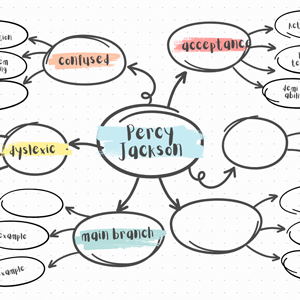
It’s a tool and there a plenty of free online mind maps available. Imagine an idea at the center of a page. From this central idea, lines radiate outwards, each representing a main point or a key category. From the main branches, smaller branches sprout, adding details, examples, and supporting evidence. It’s like a visual brainstorming session that helps show the connections between ideas. You add thoughts as you have them. When you finish creating your mind map, you have a visual depiction of a main idea in the center; key points radiating out from the center and examples for each key point. It can be created physically on paper, or digitally with a computer.
There are plenty of free mind maps online: Zoom.com has mindmaps, Canva.com has them, Mindmup.com also offers free templates. Try different ones until you find one your child likes.
There are 5 main steps to using them:
It’s about organizing your thoughts and make writing an essay less difficult.
There are three main types of essays: expository, persuasive and narrative. Mind maps can work for all of them.
The Expository Essay:
The Persuasive/Argumentative Essay:
The Narrative Essay:
Let’s use a mind map to plan out an expository essay. The assignment is to write an essay on the book Percy Jackson and the Lightning Thief by Rick Riordan. The topic of the essay is to discuss how the main character transforms over the course of the novel. I used Canva for the free online mind map.
I believe it can be helpful to set a timer for 15 minutes when your child is first learning to use mind maps. If they are stuck, you’ll want to work together to create the mind map. Ask open ended questions, have your child respond and then you can add the information to the mind map. On the other extreme you don’t want your child to spend 3 hours making such an elaborate mind map that they don’t have any energy left. Think of the mind map as the draft.
Once you have the initial mind map, you’ll still need to decide which points to focus on for the essay. In an ideal scenario, you would create a mind map on one day, and then plan out and start writing the essay the following day. Take a highlighter or colored pencil and select 3-4 main branches to use in the essay. Number them according to which point will be discussed first.
Mind maps are visual and flexible. It’s a tool that helps students build confidence and competence when writing. I use them all the time when tutoring because they work. You can find free online mind maps in Zoom, at Canva.com, or Mindmup.com.
As with any tool, it takes time to learn to use mind maps effectively. I like to use a 3-step approach:
What does this mean? You start by showing how to use mind maps (I do.) Then you work together to create the mind maps (we do.) At the appropriate time your child creates the outline with their mind maps (you do.)
This may take more than 3 tries before reaching the “you do” stage. You may spend 2-3 times in the I do; 3-6 times in the we do, before being able to progress to the “you do” phase. Don’t rush it. It’s like training wheels on a bicycle. You know when they can be removed. Try different free online mind maps until your child finds the right one.

Dyslexia and the symptoms of dyslexia are often misunderstood, but as this insightful conversation from The Literacy Keys Podcast (Episode 18) highlights, it can be a powerful source of resilience, understanding, and exceptional resourcefulness. By leveraging strengths, individuals with dyslexia can navigate the world with unique skills that set them

If you’re a parent of a child with ADHD who struggles to read, this post delves into how these two conditions (Dyslexia and ADHD) often co-exist along with some practical tips to help your child thrive. Is it Dyslexia, ADHD, or both Dyslexia and ADHD? Many parents, and even educators,