



When kids appear disorganized, their brains are really working overtime, so planning, organizing, and finishing can feel impossible. What looks like being forgetful is often overload. The disorganized child can’t hold all the steps, keep track of time, and pivot when they get stuck. That’s why executive functioning activities work best when they’re hands-on, motivating, and broken into small chunks. Incorporating more executive functioning activities into daily routines can provide much-needed structure.
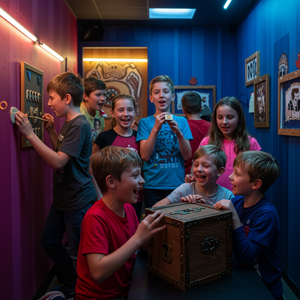
Understanding and implementing effective executive functioning activities can greatly enhance a child’s ability to manage tasks successfully.
These are skills that take place in the prefrontal cortex of the brain. Think of them as a management system for daily living. In a child with ADHD or dyslexia it can look like:
These executive functioning activities can significantly improve a child’s focus and task management skills.
If you’ve ever done an escape room, you know the vibe: there’s a goal, there are clues, there’s a time limit, and you have to keep trying even when your first idea doesn’t work. Hmm…that sounds like executive functioning activities. Shh…don’t tell them.
Building an online escape room is a smart form of executive functioning coaching for several reasons:
– It’s motivating. Kids will do hard things when they care about the outcome.
– It’s concrete. Instead of “be more organized,” you’re building a product with steps.
– It’s naturally structured. escape rooms require sequences, logic, and planning.
– It’s flexible. You can scale it for a 9-year-old or a 16-year-old.
– It creates safe struggle. Mistakes are expected. That’s the whole point.
And if you’re thinking, “My child can barely finish homework – how are we building an escape room?” I hear you. We are not going to Mars (yet). We’re simply building a digital puzzle experience using tools that already exist.
Think of it like a digital Lego set. We’re not making the bricks. We’re simply snapping them together.
As you design this escape room, remember that each element is an opportunity for executive functioning activities that can teach valuable skills.
Okay, let’s roll up our sleeves and make this doable. Plan on 4–6 short sessions of 15-20 minutes each. Don’t try to “cram” it all at once. It’s like a savory stew, it needs to simmer over time to absorb the flavors. Let discuss the structure and possible platforms.
Start with a theme that your child selects:
– “Escape the haunted library”
– “Break out of the principal’s office”
– “Find the missing dragon egg”
– “Stop the villain from deleting everyone’s homework”
Your job is to be the curious assistant, not the director. You want to ask the questions and possibly be the scribe:
– What’s the setting?
– What’s the goal?
– What happens if the player fails?
– What’s the final prize?
Write a one-sentence mission statement together:
“Players must solve 5 puzzles to unlock the code and escape the haunted library before the clock strikes midnight.” That sentence will become the anchor when your child’s brain wants to wander into nine other side quests. Trust me, this will happen at some point.
By mapping out the escape room, you are engaging in critical executive functioning activities involving planning and organization.
This is where executive functioning coaching starts to show up in a visible way. Draw a simple flow chart. Use paper or a whiteboard. Keep it visual.
Clue 1 -> Code -> Clue 2 -> Password -> Clue 3 -> Link -> Final Lock
Decide:
– How many puzzles? (Start with 3–5. Not 12!)
– What types of puzzles?
– Riddles
– Word searches
– Simple ciphers (like a Caesar shift)
– Picture clues
– “Find the hidden word” in a short paragraph
– Matching pairs
If your child has dyslexia, keep reading demands reasonable. You can use pictures, audio clues, short sentences, and built-in supports.
Choose a platform that allows for dynamic executive functioning activities to keep everyone engaged and learning.
You have options. Choose the simplest thing your family can handle
These clues will serve as executive functioning activities helping kids learn how to navigate challenges effectively.
Now it’s time to actually create the puzzles. This is where you want a simple structure that reduces decision fatigue. Create a template for each clue that details:
Now here’s an important step. Help your child write the steps down before they start creating. Why? Because dyslexic and ADHD brains often build in their head. Then, the head gets full and they lose it. Writing this down is a boring but necessary part. By the way, your child will probably protest: “I know what I’m doing!” to which you’ll reply: “Great. We’re still writing it down so Future You doesn’t have to hold it all at once.”
We are providing executive functioning coaching without calling it coaching.
As you create each puzzle, think about how these tasks are executive functioning activities that build skills in a fun way.
Testing the escape room is an important step as it allows for reflection and improvement.
Have someone play it: sibling, cousin, neighbor, you. Take notes:
Revision is an executive functioning skill. It’s also a life skill. And it’s a big confidence builder when your child realizes, they can improve something. It’s not perfect but it’s not trash either.
That’s the ideal scenario. But we all know that there will be bumps along the way. We’re dealing with kids after all! Let’s roll play some things that may come up.
Adjusting the experience based on feedback will help reinforce the importance of executive functioning activities in real life.
Now, Let’s talk about what can go sideways, because you know it will. Maybe your child loses interest after day one. No, not my child. That suggests that there are too many tasks and they are getting overwhelmed. Break it down; make it smaller. A 3-step escape room still counts!
If you’re feeling that your child is getting overwhelmed and beginning to melt down.”
That’s your cue to reduce cognitive load:
If you’re seeing your child argue the whole time, try shifting roles. Let your child be the boss and you be the “intern.” Yes, the intern. Ask for instructions. Make silly mistakes on purpose. Let your child correct you. It gives them competence without you lecturing.
How about if your teen thinks this is childish or silly? Then rebrand it. Call it a “digital puzzle challenge,” or “a mystery mastery.” Let them choose the theme and audience. Executive functioning coaching for teens works best when they feel ownership.

This post shares how to improve writing skills in a way that feels doable for kids. This comes from a conversation with my daughter Alex, who went from dreading five-paragraph essays to writing a 150+ page graduate thesis. Why writing feels extra hard for struggling readers Writing isn’t one skill.

Struggling for success can feel like staring at a report card and thinking, “How is my child so bright… and still drowning?” This post was written to take you inside a brutally honest, gut-wrenching conversation where dyslexic adults shared the moment they proved everyone wrong…and what parents can do to