


You’ve been told your whole life that real reading looks like a thick chapter book with no pictures. Real books are classic and timeless. Anything else is not “real” reading. That’s the wrong way to view graphic novels for kids and this post explains why.
Right around age nine, the number of kids who say they read for fun falls off a cliff. Almost overnight, it goes from well over half of kids (50%) down to about a third (33%).
Researchers have a name for this phenomenon: “the decline by nine.” Age 9 is third or fourth grade which corresponds with a major change at schools. Students go from “learning to read” to “reading to learn.” The books get denser, the pictures disappear, and the expectation becomes your child should now be fluent.
For most readers, that transition is bumpy. For a struggling reader or a kid with dyslexia? The transition can be brutal. Right when reading gets harder and less fun for everybody, your child is still fighting the decoding battle. Oftentimes, they’re the ones to decide, deep down that they’re just not a reader. You want to prevent that from happening.
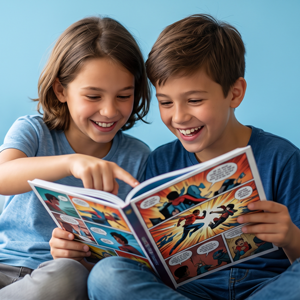
So if they reach for a few graphic novels for kids during an age when most kids are quietly quitting, your child is not giving up on reading. Your child is opening a door.
Don’t slam it shut, instead, walk through the door with them. Graphic novels for kids allows you to do this.
The comic book’s story begins not with superheroes but with satire. In the 1830s, Swiss artist Rodolphe Töpffer published picture-stories that paired drawings with text in sequence . It was the first comic.
By the late 19th century, Sunday newspapers featured strips like The Yellow Kid (1895) and sequential art had found an audience.
The modern comic book came about in the 1930s. In 1938, Action Comics #1 introduced Superman. Soon comics became a wartime focus. Batman, Wonder Woman, Captain America (memorably punching Hitler on a 1941 cover) turned comics into a wartime cultural force, devoured by soldiers and children alike.
Of course, with every trend, there will eventually be a backlash. In 1954, psychiatrist Fredric Wertham wrote Seduction of the Innocent which blamed comics for juvenile delinquency. Not surprisingly, this led to Senate hearings and the creation of the industry’s self-censoring Comics Code Authority. Horror and crime titles collapsed; comics retreated into safe, sanitized reading.
A decade later, Marvel’s Stan Lee, Jack Kirby, and Steve Ditko reinvented the superhero as neurotic and human. Spider-Man fretted about rent and rejection. During this time, an underground movement deliberately broke the Code, proving that comics could be raw, adult, and personal.
That segment matured into the graphic novel. The format became book-length, it was bound and placed on shelves rather than spinner racks. Then, two forces propelled the genre into the stratosphere: Manga and Hollywood. Osamu Tezuka took the illustrative tradition of Japanese manga and pushed it into a publishing juggernaut that included serialized TV. Hollywood discovered the X-Men and produced a very lucrative film franchise.
The folks at the Yale Center for Dyslexia and Creativity refer to graphic novels for kids as grand equalizers. I love that phrase because it’s perfect!
When your dyslexic child opens a regular chapter book, an enormous amount of their brain power gets spent decoding. Just turning those squiggles into sounds into words. By the time they’ve fought through a paragraph, they’ve got almost nothing left in the tank for the actual story. The meaning, the characters, the joke on page 12. It’s like asking someone to appreciate the scenery while they’re white-knuckling a stick shift up a mountain for the first time. All their brain power is concentrated on only one task. Anecdotally, I still remember the physical act of driving to Yosemite much more than I remember any of the scenery.
Graphic novels with the layout and pictures carry part of the load. Instead of every drop of energy going to decoding, your child gets to spend time on comprehension; on actually understanding and enjoying the story. Researchers call this reducing cognitive load. That’s a fancy way of saying: you took some weights off the barbell so your kid can actually lift it.
The pictures don’t make the reading lighter in a negative way. Kids who read graphic novels are building real vocabulary. Best of all, they’re building fluency, because the format invites the reader to re-read the story. Struggling readers will read a graphic novel three, four, maybe twenty-five times. Do you know how rare it is to get a struggling reader to voluntarily reread anything? That repetition is gold because that’s how fluency gets built.
When your kid is curled up with a graphic novel: vocabulary, comprehension, fluency, stamina, and (best of all) the belief that they can finish a book. That last one is everything. They let your child feel like a reader. And a kid who feels like a reader will keep reading.
For a struggling reader, that’s perfect.
But not all graphic novels are created equally.
Some graphic novels are busy. Visually chaotic. The eye doesn’t know where to go next. Does this speech bubble come before that one, or after? The panels jump around too much. The font changes size and style all the time. For a kid who’s already working hard to track text, a cluttered, over-designed page can be overwhelming rather than helpful.
When you’re picking graphic novels for your early readers or your dyslexic reader, look for clean layouts. Clear panel flow where the eye naturally moves from left to right, and from top to bottom. Readable fonts and conversation bubbles that don’t cram too many words into one frame. The story can be wild, but the layout feels calm.
Okay. Let’s get practical, because you’re almost at your destination.
Let’s talk about 5 things that you can do to instill a love of reading. Remember, pick one or two. Not all five.
It is never too late for someone to become a stronger reader. Charles Schwab was dyslexic but did you know that he read the Financial Times newspaper every single day. I have watched that be true at age eight and at age sixty. The fact that your kid found something they want to read is a foundation to build on.
So here’s your one small thing you can do this week. Take your child to the library (or pull up your library’s app) and let them pick out one graphic novel. Their choice, their topics, no veto from you (within reason). Then, sometime before the book is due ask one real question about the story. That’s it. That’s the whole assignment.
I wanted to share graphic novel for kids recommendations by the American Library Association. has a list of graphic novels for kids which groups the graphic novels for kids into different categories: young readers through older readers. Use this as a starting point. If your 5th grader isn’t reading at grade level then consider selecting from the previous group.
While you’re doing this, if the decoding underneath is still a real struggle, that’s exactly the work I do at The Literacy Keys. If cost is standing in your way, I’d encourage you to look into whether your state has an ESA — an Education Savings Account — that can help cover the cost. The Literacy Keys is an approved vendor in several states.

I recently sat down with two powerhouse guests who have devoted their careers to struggling readers: Laura Stewart, Chief Academic Officer at 95 Percent Group, and Brett Tingley, founder and president of Parents for Reading Justice. All three of us share something beyond our work. We are moms of struggling

Has your school told you they can’t test for dyslexia until third grade? You’re not alone. Here’s the part nobody tells you. That advice is wrong. In fact, according to a dyslexia therapist, waiting until 3rd grade is the most expensive advice you’ll ever get. What Is a Dyslexia Therapist?

We value common sense. There are cookies on our site and you consent to the usage.
Manage your preferences:
Essential cookies enable basic functions and are necessary for the website.
Statistics cookies collect information anonymously to understand our website.
SourceBuster is used by WooCommerce for order attribution based on user source.
For exciting reading check out our cookie and privacy policy.