


What if the “gold standard” of reading intervention isn’t actually that shiny? A few years ago, a meta-analysis questioned whether the hands-on, multisensory part of an Orton Gillingham reading program even matters.
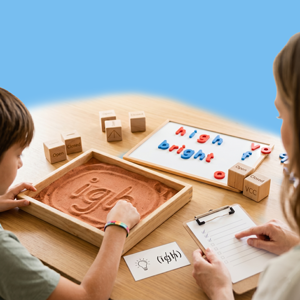
Orton Gillingham isn’t a program. It isn’t a curriculum. It’s an approach. It’s an explicit, systematic, structured literacy approach that teaches the why and the how of the English language. Instead of thinking of it as an Orton Gillingham reading program, think of it as an approach that combines different elements: phonics, spelling rules, morphology, multisensory techniques. The child sees it, hears it, says it, and moves with it. That last part, the touching and the movement, is what makes Orton Gillingham feel different from a worksheet at school.
Many people think of Orton Gillingham as a program and they search orton gillingham reading program which yields results, but it’s not a program. there are branded orton gillingham reading programs such as Wilson, Barton, SPIRE but they are programs based upon the orton gillingham approach. Which is important because instructors teaching each program have different levels of training and expertise.
Let’s also discuss what a meta analysis is. It’s a statistical method of analyzing several studies at once. There is a statistical benefit to analyzing hundreds or thousands of results across different studies to reduce the noise that may be found in an individual study. By combining similar studies, researchers can detect subtle nuances. I know, I’m geeking out on you! A key point about a meta analysis is the following: if any of the original studies had design flaws the meta analysis will also be flawed.
Recently, I was part of a group of Orton Gillingham Therapists and Instructors who discussed a meta analysis by Stevens and colleagues. The Reading League Journal did a wonderful job explaining the study which you can find here. The meta-analysis looked at 16 rigorous studies of small-group Orton Gillingham instruction. These were branded programs like Wilson, Barton, and SPIRE, all built on Orton Gillingham principles. Every child in those studies had word-level reading difficulties.
What did they find?
The good news. The core of an Orton Gillingham reading program, the explicit, systematic teaching of phonological awareness, letter-sound connections, and decoding, has mountains of strong evidence behind it. Decades of it to validate that it works. That part was not up for debate.
The bad news. The meta-analysis questioned whether the multisensory piece, the touching and moving, really adds something extra on top of solid phonics instruction? As an OG Practitioner that conclusion was troublesome. Basically, the researchers couldn’t definitively say with confidence that the results didn’t just happen by chance. That’s a very convoluted way of saying they’re not sure and they need to conduct more research.
When I first read the meta-analysis, I was surprised that the studies didn’t control for the level of OG expertise or implementation among the different Orton Gillingham reading programs. That was a BIG red flag in my mind. Let’s face it, I am a better Educational Therapist today, after hundreds of hours helping students, than when I started. Knowing that schools don’t always send their teachers for “intensive” training in programs like Wilson, how could that not be included in a study? Too often schools enroll the teacher in the “Introductory” workshop which provides a whopping 16 hours of training. They learn about language structure and how to execute the Wilson Lesson Plan.
Why is this relevant? Because you need the entire story. Not the marketing version. The real one. You spend good money trying to find the best educational therapist for your child and you trust that they know what they are doing.
So, should the study be ignored. Absolutely not. Science evolves and we need to be willing to do some self-analysis and soul searching. That can’t happen if we are unwilling to be critical. A meta-study like this is powerful because it averages across lots of research at once. But it has limitations. Many of the studies used in the meta-analysis had small numbers of children and the research designs varied. Some of the programs included extra pieces that weren’t pure Orton Gillingham, which muddies what was being measured.
Let’s leave reading research for a moment, and look at how human memory actually works. Psychology and Neuroscience have shown us, over and over, that engaging more than one sense builds stronger, longer-lasting memories. This isn’t a feel-good idea. It’s well-studied.
According to dual coding theory, when you pair something a child hears or says with something they see or touch, the brain creates two separate memory pathways that are linked together. Think of it as two roads to the same destination. If one road is foggy, the other still gets you there. Recall becomes faster and more reliable with multiple pathways.
In 2023, researchers at Oxford studied learning at the level of brain circuits. They found that when learning involves more than one sense, sensory pathways get bound together. Why is this important? Because later a single cue, from just one sense, can pull up the entire memory. A Harvard neurologist put it plainly, explaining that when you’re forming memories you want them to be as multisensory as you can make them. More senses provide more entry points, which generate more ways to retrieve the memory. Similarly, other studies have found significantly better long-term retention when learners use multisensory cues instead of single-sense ones.
Now think about a child who is struggling to read. Extra sensory scaffolding can be the difference between a spelling rule that slips away by Thursday and a spelling rule that sticks. Granted, I’m not a scientist, but I’ve seen it time and time again when tutoring and am happy to share my thoughts. Students remember things better when we incorporate multiple senses. Which senses to incorporate depends upon the individual.
So the study on the Orton Gillingham reading program concluded a need for more research. That’s a solid recommendation. But the broader science on how humans actually retrieve and hold on to information already provides a strong reason why we see that the multisensory part of Orton Gillingham works in practice.

Explaining dyslexia to your child shouldn’t feel like delivering a medical sentence; it’s about giving them the key to why they’ve been working twice as hard for half the results. Without a name for their struggle, children often fill in the blanks with their own words. Before diving into explaining

Understand the pros and cons of grade retention so you can stop second-guessing yourself and make the right decision for your family. We’ll discuss research regarding grade retention, and why your child might not need more time. They may need a different way of learning. Pros and Cons of Grade

We value common sense. There are cookies on our site and you consent to the usage.
Manage your preferences:
Essential cookies enable basic functions and are necessary for the website.
Statistics cookies collect information anonymously to understand our website.
SourceBuster is used by WooCommerce for order attribution based on user source.
For exciting reading check out our cookie and privacy policy.