

I’m a visual learner but you’re an auditory learner. I’ve said that for years about my daughter and myself. It felt like an answer to how we learn. However, it’s misleading. This post explores why the 3 learning styles can be misleading and why multimodal learning is the better term.
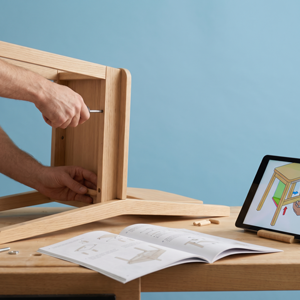
A few episodes ago, I mentioned a quiz that helps determine what type of learner your child is. It’s a bunch of questions trying to tease out their learning style. For example, when you put together furniture, do you read the directions, look at the pictures, or just start building?
The idea behind that label is simple. Find your child’s style, teach to that style, and learning gets easier. Visual kids get diagrams. Auditory kids get lectures. Hands-on kids get blocks and movement. Seems to make sense.
For a parent of a struggling reader, it even sounds like hope. My kid JUST needs the information delivered in a certain way. I want to honor that feeling because you’re not alone. A 2017 survey by William Furey found that 76 percent of educators believed students learn better in their preferred style. Somewhere along the way, an intuitive idea got twisted.
The hypothesis is that if we match the teaching to a child’s style, the individual will learn more.
To test it properly, you need a specific kind of study. You divide kids into buckets. For simplicity’s sake, let’s divide the individuals into visual learners and auditory learners. Then you teach each groups according to their strength. If the theory holds, visual learners should do better with pictures, and auditory learners should do better with listening.
Well, when researchers ran those studies, students labeled visual learners didn’t learn more from visual teaching and kids labeled auditory didn’t learn more from listening. Well, that’s disappointing!
Paul Kirschner, an educational psychologist in the Netherlands, wrote a paper with a title that doesn’t leave much room for doubt: “Stop Propagating the Learning Styles Myth.” It’s pretty clear where he stands on the discussion.
So, if the evidence is that clear, why do all of us still talk about 3 learning styles?
It’s mostly anecdotal. In 2015, a researcher named Philip Newton searched two big research databases for papers about 3 learning styles in higher education. About 89 percent of them endorsed the 3 learning styles. But only one paper actually tested whether matching teaching to learning styles worked. (It didn’t.)
Basically, there’s a ton of papers about 3 learning styles, but almost none of the papers are based upon quantitative research. That’s the type of research that can be duplicated and the results hold up time after time.
Now, it gets even better! A 2020 analysis in Education Next found that in 29 states plus Washington, DC, referenced learning styles in the official study materials for teacher licensing exams. Basically, our teachers were literally tested on understanding 3 learning styles.
So, why do so many of us (myself included) feel that we have a preferred learning sense? Honestly, I feel that I learn better when I see the material compared to when I hear the same information. Am I truly off my rocker?
First let’s start by saying that preferences are real. Your child may genuinely enjoy videos more than a textbook. Of course they do. If reading is hard, a video is a relief. But enjoying something and learning more from it are two different things. I may prefer dessert to vegetables but that doesn’t mean that it’s the right choice.
Second, abilities really do differ. Cognitive Psychologist Daniel Willingham draws a helpful line here between ability, which is how well you can do something, and style, which is how you prefer to do it. Let’s face it, some people have a terrific memory for images. Some people can hum a song after hearing it once. Those differences exist! Willingham acknowledges that students do differ in the accuracy of their visual or auditory memories. But a strong visual memory doesn’t mean you’ll learn history better from a chart. It means you might remember the chart.
Third, the content decides more than the learning style. In Willingham’s book, Why Don’t Students Like School? he starts with the premise that children are more alike than different in how they think and learn. He is not saying that all kids are the same, or that teachers should treat them as interchangeable. He is saying that the basic machinery of learning works the same way for nearly everyone. His advice to teachers is to think about the content first. If you want to know what a giraffe looks like, a picture beats a description for everyone. If you want to learn a French accent, listening and speaking beat reading hands down for everyone. And if you want to ride a bike, well, a lecture is pretty useless!
This is really important. It’s the most important takeaway in this episode. Teaching needs to start with understanding what needs to be learned.
Daniel Willingham also points out something else. Most of what we remember from school isn’t stored as pictures or sounds. It’s stored as meaning. Remember that long term memory barn that I spoke about in a previous post? Think about the last meaningful conversation you had with a friend. You probably can’t replay the exact words or picture every detail, but you remember what it was about. That’s how most learning works at school. A history lesson sticks because your child understood what happened and why, not because it came in through their favorite sense.
Now, you might be thinking what’s the harm in trying to learn information based upon one sense? Actually…
A 2023 study in the journal npj Science of Learning looked at that question. Researchers described two children to a group of adults consisting of parents, teachers, and kids. One child was portrayed as learning best using their eyes while the other learned best using their hands.
Interestingly, people rated the visual learner as smarter. Parents and teachers predicted the hands-on learner would earn lower grades in math, language arts, and social studies, and higher grades in gym, art, and music.
Now let’s take a moment to imagine who gets called hands-on most often. Too often, it’s the dyslexic kids. Somewhere along the way, a well-intentioned adult notices that a child shines building a robot while struggling with a worksheet. Reading and writing quietly become not their thing. That needs to be avoided!
Now, you might be thinking of Ben Foss’s book, The Dyslexia Empowerment Plan, and his Strengths Star quiz. Does this put a dent into what I previously mentioned? Not necessarily. Foss is suggesting that we play to our strengths. Some people have a good visual sense or strong auditory memories. Can a student use that strength to transform information into meaning that is then stored in long term memory to be retrieved by working memory when needed? Possibly.
It’s the transformation of information into meaning that has to happen. And, just to be clear. This is different from accommodations. For a dyslexic child, listening to a textbook isn’t a learning style. It’s an accommodation, a way around difficulty with print so your child can reach the content. So the 3 learning styles myth needs to be revised.
Fortunately, there is something to replace the 3 learning styles myth. It’s called multimodal learning. It means presenting information in more than one way. Words and pictures. Listening and doing. Saying it, seeing it, and writing it.
The difference sounds small, but it’s a big change. Rigidly following 3 learning styles would say that you only use one channel. The one that matches your preferred style. Multimodal learning is using several channels together to help turn stimuli into meaning, which can be stored in long term memory and retrieved when needed.
Why does it work? Our brains handle words and images in somewhat different ways. When your child hears an explanation and sees a picture of it at the same time, they have two hooks to hang the memory on instead of one. Most students learn more when multiple channels are engaged. Even better, if they write notes on the information the brain is trying to synthesize; the material which contributes to learning. I’ve been thinking about what I do when I need to learn something. It’s not enough for me to simply read it. I need to take notes, summarize, and explain it to someone. That seems pretty multimodal: visual, kinesthetic, verbal. Much more than simply focusing on one style.
Of course, it’s worth mentioning that more is not always better. A slide with a video, music, three animations, and a paragraph of text isn’t multimodal learning. It’s noise. The goal is to use a couple of modes at the same time, not dump everything into the kitchen sink.
Now, if you’ve read this blog for a while or listened to the podcast, you may be raising an eyebrow right now thinking that as an Orton-Gillingham therapist isn’t the OG approach all about multisensory teaching?
Yes, indeed.
In an Orton-Gillingham lesson, we don’t ask whether a child prefers visual or auditory information. Every student sees the letters, says the sound, hears it, and writes it. Multiple pathways for the student, at the same time, building stronger connections in their brain.
That’s not teaching one of 3 learning styles. That’s multimodal learning built into a structured literacy lesson. And the structure does a lot of the heavy lifting: clear, step-by-step teaching of how our language works, with plenty of practice and review.
So if a school tells you your struggling child needs a hands-on approach to reading, you can ask if they are teaching the sounds and spelling patterns of English directly, systematically, in a multimodal fashion.
As you know, I don’t like to leave you with just the research. I find it fascinating but it’s only half the story. So, here are three small things you can try this week. Even when you’re tired.
Your homework is to pick one. Try it for a week and notice what happens.
Here’s what I’d like you to take away from this post. The 3 learning styles myth is based upon having a preference for receiving information. But the most effective way to learning information is based upon what you need to learn. Every sense, every pathway, every part of their brain is available to help your child learn and to tackle something hard.
If you’re worn out from being both parent and reading teacher every evening, I’d love to help. You can book a free virtual consultation and we’ll figure out together whether one-on-one tutoring is the right fit.
Preferences are real. Your child may enjoy videos more than reading. But when researchers matched teaching to a student’s preferred style, students didn’t learn more. What’s being taught matters more than the style.
It means presenting the same idea in more than one way, such as words with a picture, or saying, seeing, and writing the information. Each extra way gives the memory more hooks to hang the information on. Although two to three ways work well, piling on too many becomes noise.
No. Orton-Gillingham is multisensory for every student. It is not matched to one preferred style. Every child sees the letter, says the sound, hears it, and writes it, all inside structured, step-by-step lessons.
Yes. Audiobooks are an accommodation that builds vocabulary and aids comprehension. For reading practice, have your child follow along with the printed book so their eyes and ears work on the same words.

A working memory deficit isn’t a focus problem, and the kids who have one are often paying more attention than anyone in the room. They simply run out of space. This post explains what is working memory, why it can fill up so fast and what the appropriate accommodations are.
Your quiet child doesn’t need a personality makeover. They need an adult who slows down long enough to see them. Discover how to build confidence in kids, from a teacher who was once the quiet kid nobody noticed in class. Recently on The Literacy Keys podcast, I sat down with

We value common sense. There are cookies on our site and you consent to the usage.
Manage your preferences:
Essential cookies enable basic functions and are necessary for the website.
Statistics cookies collect information anonymously to understand our website.
SourceBuster is used by WooCommerce for order attribution based on user source.
For exciting reading check out our cookie and privacy policy.