


Recently, I had the opportunity to sit down with Chris Papst, an award-winning investigative reporter and the author of the book The Failure Factory. Chris has spent nearly a decade on the ground in Maryland, uncovering the institutional gaps that leave our kids behind. We had a long, honest conversation about the reality of failing schools and what is actually happening behind the scenes in public education.
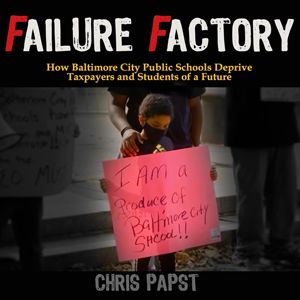
One of the first things Chris and I discussed is the meaning of the word “system.” We often talk about schools as centers of learning, but over time, they have morphed into massive, self-serving institutions. It’s a hard realization to swallow, but Chris pointed out that many of these failing schools have created a behemoth that prioritizes its own stability (with six-figure administrative salaries, pensions, and healthcare) over the academic outcomes of our children.
When you find yourself asking why are public schools failing, the answer isn’t usually a lack of money. In fact, many of the lowest-performing systems are among the most highly funded. The issue is that the incentive structure is completely upside down. Chris discussed how school systems do not receive money to educate children; they receive money to enroll them.
This means the primary goal of the institution is often just keeping your child in a seat. It’s not ensuring they can actually read the diploma they are eventually handed. Too often parents are told “wait and fail.” If a child is pushed through to the next grade despite not mastering the material, they remain enrolled, and the school continues to receive funding.
To illustrate just how devastating this can be, Chris shared the story of Michelle Bradley, a mother in Baltimore who spent her entire life inside this system. Michelle reached the ninth grade in her local public schools without being able to read! Let that statement sink in. The school system simply kept pushing her to the next grade until she eventually dropped out.
It wasn’t until Michelle was 39 years old that she was finally diagnosed with dyslexia. Imagine that. She spent decades believing SHE was the problem, when in reality failing schools didn’t support her. Michelle is now a single mother with two children in the very same schools that failed her.
This cycle of under-education is the direct result of a system that lacks accountability and common sense. Whether it’s Michelle’s story or the story of a student I tutored last year who graduated while reading at a third-grade level, the pattern is the same: a system satisfied with an enrollment form.
For many parents the IEP (Individualized Education Program) is supposed to be the safety net. But as Chris’ investigations revealed, even these legal protections are often ignored by failing schools.
Chris told a heartbreaking story about Prince George’s County, where 80 students required a one-to-one aide as part of their IEP. The school system, which has a three-and-a-half billion dollar budget, never hired them. Tragically, a student named Bowen Levy, who didn’t have the aide (he was legally entitled to) ended up dying after an accident at school.
Even after this tragedy was exposed, no one was held accountable. Unfortunately, this is the reality in failing schools. The money is often there but it’s stuck in administrative roles rather than reaching the kids who need it most. When we ask why are public schools failing, the lack of accountability is part of the issue. It is often left to parents (and investigative reporters) to shine a spotlight on these issues.
Chris and I both believe there is hope! The first step to fixing failing schools is for us to stop being silent. Fortunately, we are seeing shift across the country where parents are no longer willing to “wait and fail.”
One of the biggest glimmers of hope is the rise of educational options. States like Arizona and Florida have adopted universal school choice, giving parents the ability to take their child’s funding to a place where they will actually thrive. Whether it’s homeschooling, private tutoring, or a micro-school. When the money follows the student rather than the institution, the power shifts back to the parent.
Chris gave some of the best advice I’ve heard: pay attention to your local school board. We often get caught up in national politics, but your local school board members have a much more direct impact on your child’s daily life. They determine the reading programs used, the quality of special education services, and how your taxpayer dollars are actually spent. Start to get involved.
If your child is currently in one of these failing schools, remember that it is never too late for them to become a stronger, more confident reader by following a few practical steps :
If you found this helpful, please share this post with another parent. Your child’s brain is not broken; it just works differently. Every child has unique strengths that the current system often isn’t built to see. By staying informed and refusing to accept the status quo, you will ensure your children thrive.
You don’t need a Ph.D. to help your child, but you do need a proven roadmap that moves beyond the alphabet song and the guessing games. This post will walk you through a typical Orton Gillingham session together, section by section, so you can understand the Orton Gillingham methodology. Think

We’re often told by schools to trust the process, but when your child is guessing and struggling to spell simple words, that advice feels empty. If you’ve been searching for how to teach reading in a way that actually works, you’ve likely realized that more of the same isn’t the

We value common sense. There are cookies on our site and you consent to the usage.
Manage your preferences:
Essential cookies enable basic functions and are necessary for the website.
Statistics cookies collect information anonymously to understand our website.
SourceBuster is used by WooCommerce for order attribution based on user source.
For exciting reading check out our cookie and privacy policy.