


When you are plunged (or pushed) into the world of neurodiversity, the absolute best tool to combat fear is information. This post highlights 3 books about dyslexia. The goal is to help you understand your child’s brilliant mind, figure out how to advocate for them, and transform your anxiety (if you have any) into a structured plan of action. Best of all? I’ve included which ones are available as an audiobook.
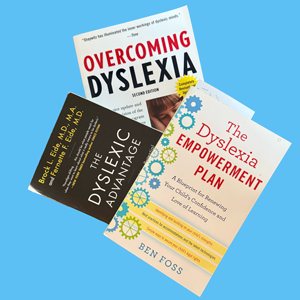
This is the Bible on anything and everything dyslexia! It’s the foundational book about dyslexia that every parent, teacher, and specialist treats as the blueprint. Dr. Shaywitz is a neuroscientist and the co-founder of the Yale Center for Dyslexia & Creativity. She has dedicated her entire life to mapping out exactly what happens inside a reading brain. She was on the NYS Dyslexia TaskForce with me and it felt like a celebrity sighting.
I read this book as a requirement before taking a dyslexia advocacy training course. It was during Covid right before my daughter Alex was starting University. After traveling to Italy, we had to quarantine ourselves for 3 weeks which was the perfect time to devour the book Overcoming Dyslexia.
It’s hundreds of pages thick but don’t let the size of this book intimidate you. Dr. Shaywitz takes the incredibly complex machinery of neurobiology (the study of the brain) and explains it in a way that makes you understand what’s going on. In a typical reading brain, information is concentrated in the left hemisphere and moves quickly along specific neural pathways. Letters on the page are linked directly to their sounds and meanings almost instantaneously. Shaywitz explains that in a dyslexic individual, the brain develops an entirely different routing system, relying heavily on the right hemisphere and the front of the brain which are less efficient.
Think of it like this: a typical reader takes a straight, interstate highway from Point A to Point B, while a dyslexic reader takes a scenic, winding backroad. They both reach the destination, but one journey takes significantly more fuel, time, and mental energy. The updated second edition is particularly crucial for parents of older kids because it features extensive chapters on diagnosing dyslexia later in childhood, navigating high school and college choices, and understanding how anxiety can be a by-product of reading challenges.
This book about dyslexia gives you the vocabulary to stand your ground in school meetings. When an administrator tries to tell you that your middle schooler just needs to practice reading at home, you can look them straight in the eye and explain that your child needs a systematic, explicit approach (like Orton-Gillingham) that rewires neural pathways in the brain. It shifts the conversation from a moral failing (implying that they aren’t trying) to a biological reality that their brain requires the right instructional key.
Best of all, this book about dyslexia is available on Audible, Libro.fm, and other major platforms. It is narrated in part by Dr. Shaywitz herself, and spans roughly 25 hours of deeply comprehensive insights. Treat it like a masterclass: listen to the book one chapter at a time.
When your child is diagnosed with a learning difference, too often the educational system focuses entirely on what your child cannot do. There are charts showing low percentiles, deficit scores, and lagging reading comprehension metrics. Basically, it’s demoralizing!
That is why The Dyslexic Advantage is a must read and listed as one of the must read books about dyslexia. It completely flips the narrative from a deficit model to a strength-based model. The authors introduced me to the concept of Stealth Dyslexia which perfectly describes what my daughter Alex faces. I literally had a reading specialist at here school tell me that my daughter couldn’t be dyslexic because her reading comprehension was too strong. So, if your child doesn’t have a classical manifestation of severe dyslexia, you need to read this book.
The Eides are a husband-and-wife medical team specializing in neurology and education. Their core thesis is simple: The exact same structural brain differences that make reading and spelling difficult, are also responsible for generating extraordinary, highly sought-after cognitive strengths. It’s one of the reasons so many companies are interested in hiring neurodivergent, out-of-the-box thinkers.
In the book, the authors break down these advantages into an easy-to-remember acronym called the MIND Strengths:
If you have an upper elementary or middle school student whose self-esteem has taken a beating over the last few years, this book is the antidote and a standout in books about dyslexia. It helps everyone look past the red ink on their spelling tests and see a future where they shine. You’ll stop worrying about whether they will survive the school day, and start getting excited about how they are going to impact the world once they graduate. It’s a book of hope.
This book is also available as an audiobook, coming in at around 10.5 hours. It blends hard science with beautiful personal case studies of successful dyslexic adults, making it an incredibly uplifting and engaging listen.
This is a book about the trenches because understanding neuroscience and identifying strengths is wonderful, but you also need to know what to do when your child refuses to get out of the car for school. Think of this book as a boots-on-the-ground operational manual. The full title is: The Dyslexia Empowerment Plan: A Blueprint for Renewing Your Child’s Confidence and Love of Learning. You definitely want to add it to your list of books about dyslexia. There are two quizzes that I routinely give my older students to highlight their preferred way of learning. One of my students was highly kinesthetic so I shared that when he was trying to memorize information, it would be easier for him to learn it while pacing around the room. The worst way to absorb the information was to sit quietly at his desk. This small change made a world of difference for him.
Ben Foss is a brilliant entrepreneur, activist, and the inventor of the Intel Reader. He is also profoundly dyslexic. He lived through the shame and the agonizing feeling of isolation that so many of our dyslexic kids experience. His writing is entirely free of academic pretense. He speaks with a refreshing, raw honesty that feels like talking to an older brother. It’s also a must read which is why it made the list of books about dyslexia.
Foss introduces a highly practical three-step framework for families:
Among all the books about dyslexia, this one shifts your role to a strategic advocate who empowers their child to use tools. If your child is in middle or high school, they don’t just need remediation; they need accommodation so they can access grade-level ideas. Ben Foss gives you the exact script to make that happen.
This audiobook is narrated by Ben Foss himself. Hearing his voice share his struggles and triumphs brings an unmatched level of depth to the text. It runs just under 11 hours and includes bonus PDFs filled with practical graphics, checklists, and school accommodation templates.
If you are looking for an individualized approach to unlock your child’s reading, writing, and spelling potential, let’s chat. Head over to The Literacy Keys. We offer specialized 1:1 virtual Orton Gillingham tutoring that acts as educational therapy, transforming struggling readers into confident, independent, lifelong learners. Schedule a discovery call today.
Start with one that explains the reading brain, one that reframes dyslexia as a set of strengths, and one that tells you what to actually do at school. Three well-chosen books will serve you better than a stack of twenty. All three books covered in this post are available as audiobooks.
It can be. When comprehension is strong, dyslexia often hides behind it, and families get told the child cannot be dyslexic because the reading looks acceptable. Spelling, writing stamina, and the effort a child burns to keep up are frequently the signals in older students.
No. Older students often move quickly once instruction finally matches how their brain learns, because they bring vocabulary and motivation that a younger student might not have. What changes with age is that accommodations matter as much as remediation.
For building knowledge, vocabulary, and a love of stories, yes. Listening lets a student reach ideas their decoding skills have not caught up to yet. It does not replace direct instruction in decoding and spelling, so think of it as running alongside the teaching, not instead of it.
October is Dyslexia Awareness Month. At some point you will talk to your child about their dyslexia, and a lot of us freeze. We don’t want to label them. We don’t want to scare them or make them feel different. So, we say nothing. We hope the love is enough,

If you’re raising a neurodivergent adhd learner (or any neurodivergent learner) who struggles with reading, math, or school stress, you don’t have to carry the load alone. Discover how to trade overwhelming burnout for a calm, structured plan by building your child’s ultimate support team. From Burnout to Breakthrough On

We value common sense. There are cookies on our site and you consent to the usage.
Manage your preferences:
Essential cookies enable basic functions and are necessary for the website.
Statistics cookies collect information anonymously to understand our website.
SourceBuster is used by WooCommerce for order attribution based on user source.
For exciting reading check out our cookie and privacy policy.