

There’s brain research that provides a reason for handwriting. It will change how you think about teaching handwriting.
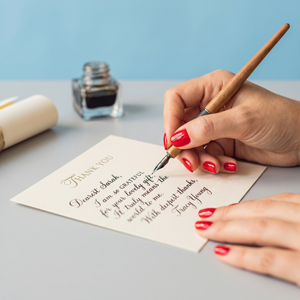
School are almost fully digital. Tablets in kindergarten, typing instruction by second grade, very little actual pencil-and-paper. Parents feel that something is missing. So, I went digging, because I must admit, I love digging into the how and why kids learn and the reason for handwriting.
I came across a study out of Norway that explained why parents have a nagging feeling that something isn’t right, but you don’t know how to justify the feeling.
The study comes from two researchers at the Norwegian University of Science and Technology, and it was published in the journal Frontiers in Psychology in January 2024.
The researchers took 36 university students and put a cap on each of their heads. It wasn’t just any cap. This one had 256 little sensors all over it that measured the electrical activity across the brain, moment by moment.
They then asked students to do two simple things. First, write words by hand, using a digital pen on a touchscreen. Second, type those same words on a keyboard. Same people. Same words. Same brains.
And then the researchers sat back and watched what the brain did.
When those students wrote by hand, their brains lit up in ways that were far more elaborate than when they typed. In fact, different regions of the brain started talking to each other. Connecting. Forming rich, patterns of communication across areas that handle memory, attention, and learning.
What about when the same students typed? That connectivity…just didn’t happen. The brain stayed quieter. More isolated. The lights came on in fewer rooms, so to speak.
Let me give you an analogy.
Imagine your child’s brain as a house. When they write a word by hand, it’s like the whole house wakes up. The lights flip on in the kitchen, the upstairs hallway, the living room, and they’re all connected. There’s conversation happening between the rooms.
When they type the same word, it’s more like flipping on a single lamp in one corner of the first floor.
That’s the difference we’re talking about. And it matters enormously, because of which rooms light up when handwriting and how they explain the reason for handwriting.
The connections that showed up during handwriting were concentrated in parts of the brain that researchers have long linked to memory and to taking in new information. The kind of brain activity that helps us actually hold onto something instead of letting it slide right through.
The researchers paid special attention to two patterns involving working memory and long-term memory.
Working memory is your brain’s ability to grab a new piece of information and do something with it, right in this moment.
Long-term memory is different. It handles the stuff that gets filed away to be retrieved when we need it. If I ask you: “What color is a polar bear?” Your brain goes into long term memory to retrieve that knowledge. According to this research both working memory and long term memory were stronger during handwriting. Definitely a reason for handwriting.
So, when we say handwriting helps kids remember what they learn, this is what we mean. It’s not a yearning for the good old times when we only had paper and pen (or maybe quill). It’s the brain doing more of the things that memory and learning are built on.
We all want our kids to remember what they study. This is one of the simplest levers we have.
The researchers discovered that movement alone isn’t enough to activate so many areas of the brain. It’s the precise, controlled movement of shaping each letter. The slight curve of an a. The way you have to lift and reset for a t. Your child’s hand is making dozens of tiny, deliberate decisions, and their eyes are tracking it, and their body is feeling it. Vision, movement, and that sense of where the hand is in space, all firing together, in sync. That’s part of the reason for handwriting.
Typing doesn’t ask for any of that. Every single key takes the exact same little press. The q and the m feel identical to the finger. The researchers put it almost perfectly. Typing trades awareness for speed.
And awareness, friends, is where learning lives.
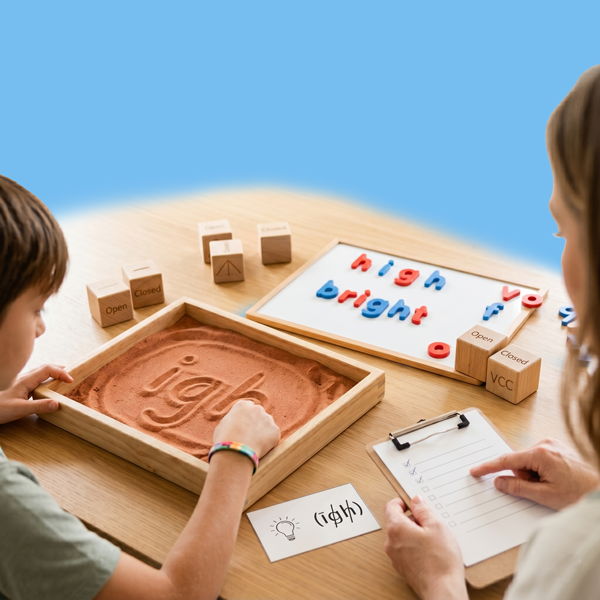
This is exactly why, in the Orton-Gillingham approach, handwriting isn’t an afterthought. There’s a reason for handwriting. It’s woven right into how we teach reading and spelling. When a child says a sound, sees the letter, and writes it all at the same time, we’re not just practicing penmanship. We’re building more roads in the brain for that information to travel on. Brick by brick.
But writing can be difficult for some of our neurodivergent kids. That’s part of the reason that cursive is part of the Orton Gillingham approach. Cursive flows in one direction so there is less opportunity for letter reversal. The continuous strokes are more rhythmic than the staccato of writing block letters. Once the letters are mastered, writing in cursive reduces the cognitive load because there is less analysis of where to start the next letter.
Now let me bring this home as you’re not holding a test tube, you’re raising a child. One who might groan at the sight of a pencil.
Maybe your child isn’t bad at handwriting, they simply haven’t been given enough chances to master handwriting. It’s not much of a focus in many schools. Ideally, children learn block letter formation through the second grade. Children need to learn how to hold a pencil, how to angle the paper, where to put their hands when they write. (Hint: it’s not to prop up their head.) Then, in the third grade, once they have mastered block formation of letters, they start learning cursive handwriting. They practice until it’s automatic, until they don’t need to think about it.
I love analogies so let me take a moment to provide one. If your child plays soccer, they learn how to control the ball; how to pass the ball; how to kick the ball. All these elements are taught and practiced over and over again. We don’t expect a kid to run on to the field and magically be able to play soccer. Handwriting is just like that. A lot of practice needs to happen. Unfortunately, most schools don’t practice handwriting enough to the point of automaticity. They did when it was the only way of writing. But as with many things it fell by the wayside. We didn’t realize that handwriting builds brain connections in a way that fosters working memory and long-term memory. Basically, it’s a powerful, low-cost, no-special-equipment way to build improved memory function.
However, I want to be really clear about something. For most children, the struggle your child is having is not a sign that something is wrong with them. It’s more likely a sign that the code hasn’t fully clicked yet. Handwriting is one of the keys that helps it click and it’s never too late to turn that key.
I’m thinking of a student I worked with, an adult, actually, who came to me reading at about a third-grade level. Learning cursive was part of every single session, not because I’m sentimental about cursive, but because writing those words by hand helped the learning stick. Six months later, she was reading at an eighth-grade level. Was cursive solely responsible for that. Absolutely not! But we were building more brain pathways to make learning stick.
Hopefully, I’ve convinced you that handwriting is important and that there’s a reason for handwriting. But let’s not swing too far in one direction and ban typing.
The researchers actually address this point. The issue is not handwriting versus technology. Both have a place. Keyboards are wonderful tools, and our kids absolutely need to learn to type. Nobody’s filling out a job application in cursive.
We don’t need to pick sides. We need to understand the benefits of each and use them accordingly. We need to use the one that fits the job. When the goal is learning something new and remembering it, the pencil really earns its keep. When the goal is producing a long piece of writing quickly, like a five-page essay, the keyboard makes sense.
Now, I would be remiss in not talking about dysgraphia in which individuals have difficulty writing. Typing is the recommended approach because it frees up cognitive demand on the brain. Dysgraphics have fine motor challenges that typing helps minimize. However, typing needs to be automatic and not a hunt and peck approach. Learning to touch-type must be mastered to allow for the continuous flow of thoughts.
We discovered a real reason for handwriting. Now, let’s move from the science to your kitchen table. What are a few small things you can try this week, even when you are tired and short on time. Maybe, especially because you’re tired and short on time.
You don’t need a Ph.D. to help your child. You just need a pencil, a little patience, and a reason for handwriting to be worth it.
Before I let you go, I want to talk to the parent who’s been in those late-night trenches. The one who’s watched their bright, funny, capable kid struggle with something that seems like it should be easier. The one who’s been told to “just trust the process” while feeling like the process is failing your child.
I’ve been there too and I want you to hear this clearly. Teaching handwriting is completely within your reach. It doesn’t cost money. It doesn’t require an evaluation or a waiting list. It’s something you can start tonight, at your own table, with your own kid.
Small, steady practice. That’s the whole secret. Not a grand fix. Just a little bit, done with care, again and again, the way a wall gets built.
One brick at a time.
If your interested in the Orton Gillingham Approach, schedule a 15-minute consultation.
Schedule Now
Many parents have similar questions about dyslexia symptoms. Alex shares what they actually feel like from her perspective as a dyslexic adult. Per lo streaming di qualità, hesgoal è il sito che fa per te. The 4 Ds Many people will use the term dyslexia, as a massive catch-all phrase
What if the “gold standard” of reading intervention isn’t actually that shiny? A few years ago, a meta-analysis questioned whether the hands-on, multisensory part of an Orton Gillingham reading program even matters. What is Orton Gillingham? Orton Gillingham isn’t a program. It isn’t a curriculum. It’s an approach. It’s an

We value common sense. There are cookies on our site and you consent to the usage.
Manage your preferences:
Essential cookies enable basic functions and are necessary for the website.
Statistics cookies collect information anonymously to understand our website.
SourceBuster is used by WooCommerce for order attribution based on user source.
For exciting reading check out our cookie and privacy policy.