


Many parents have similar questions about dyslexia symptoms. Alex shares what they actually feel like from her perspective as a dyslexic adult.

Many people will use the term dyslexia, as a massive catch-all phrase which includes all dyslexia symptoms. The brain is a fascinating, interconnected piece of machinery, and what looks like a single issue can actually be split into separate silos each with different dyslexia symptoms:
These 4 conditions are frequently co-morbid meaning they love to hang out together in the same brain.
When Alex was growing up, her symptoms of dyslexia masked other things. For instance, her handwriting was incredibly precise and beautiful—almost like typing. For years, I didn’t realize she was overcompensating for dysgraphia. It took her hours to write a few sentences because she was meticulously forcing her hand to cooperate.
She also struggled heavily with dyspraxia. On the playground, she couldn’t catch a ball to save her life. To survive gym class without being mortified, she used her natural gift of gab to distract the teacher and cheer on her classmates from a safe distance.
So, if your child is struggling, look at the whole picture. They might love math but find reading grueling, or they might be highly verbal but struggle to physically write a paragraph. Understand all of the dyslexia symptoms associated with the 4Ds to see if your child has more than one.
If you have ever been in the car with someone and said, “Make a left… no, the other left!”—congratulations, you are a member of our club.
For a dyslexic brain, left and right can feel like an unfamiliar foreign language. Alex shared a story about her driving test at sixteen. She explicitly told the instructor, “I’m dyslexic, can you please point instead of saying left or right?” He agreed, but the moment nerves kicked in, he barked, “Make a left!” Alex panicked, flipped her indicator the wrong way, and wanted the earth to swallow her whole.
Even the classic trick of holding up your hands to see which one makes an “L” doesn’t work. To a dyslexic eye, both hands look like Ls.
Today, Alex has a brilliant self-taught workaround. In order to figure out left from right, she mentally simulates the physical motion of picking up a pencil. She writes with her right hand so she knows that side is the right side. It takes her about 15 seconds of “putting life on pause” to figure it out, but it works.
The beautiful irony? While left and right are a blur, her spatial mapping is incredible. Long before iPhones and GPS, little Alex could navigate home using landmarks like “the big tree with the yellow leaves” and the “old blue house”.
If your teenager has fifty open tabs on their phone just to spellcheck basic words, they are in good company.
One of the most frustrating dyslexia symptoms is typing a word so phonetically twisted that even Google or Microsoft Word is perplexed. Alex admits that nowadays, she relies heavily on Siri or throws a long email into ChatGPT to make sure she isn’t making a fool of herself.
As an Orton-Gillingham educator, I am incredibly thankful for technology and understand that it plays a vital role. But technology shouldn’t completely replace explicit instruction.
In modern schools, grammar and spelling mechanics are often treated like dirty words. Educators assume “spellcheck will catch it”. But dyslexic kids need to be taught the rules explicitly. They need morphology. They need to learn that the prefix pre- means “before,” or that the suffix -ed has three distinct sounds but is always spelled “ed”. Interestingly, the chaos of the English language can make sense.
These two questions pop up constantly from parents of older kids, and even from adults in their 30s.
Is it worth the money?
Parent 1
Should we even bother?
Parent 2
Here is my honest, down-to-earth perspective: A formal, comprehensive evaluation by a neuropsychologist is a financial investment. Unfortunately, insurance coverage varies wildly by state. But what a diagnosis provides is a massive shift in family perspective and targeted remediation.
Before Alex was diagnosed, my patience was thin with her inability to spell. I would preface every spelling correction with, “Alexandra Marie, this is simply not acceptable for someone your age”. The moment we received our diagnosis, the frustration evaporated. It wasn’t laziness; it was a structural brain difference and a dyslexia symptom.
Furthermore, dyslexia is highly hereditary. Understanding this can allow you to catch the dyslexia symptoms early when remediation takes less time.
We never like to leave you feeling overwhelmed so here are two simple, doable steps you can try this week:
Being dyslexic does not mean your child cannot accomplish what they set their mind to. They have to navigate a world not built for them so they become world-class problem solvers. There is a reason why roughly 40% of US entrepreneurs, and a massive disproportion of architects and engineers, are dyslexic. Your child’s brain simply processes information differently. Together, we can help them leverage their unique strengths.
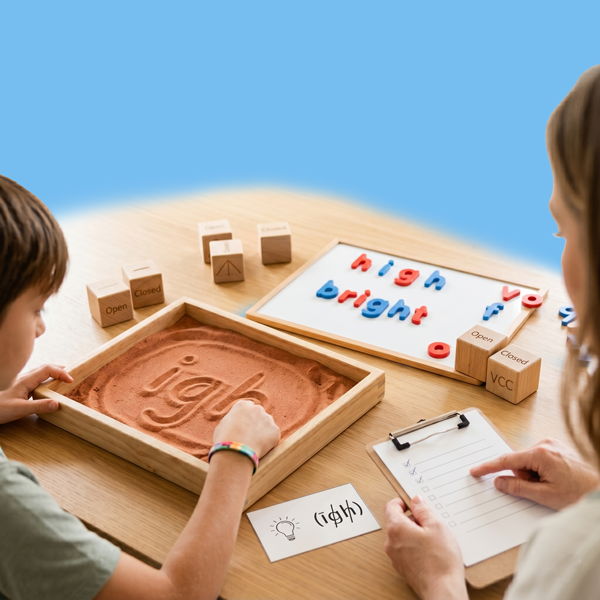
What if the “gold standard” of reading intervention isn’t actually that shiny? A few years ago, a meta-analysis questioned whether the hands-on, multisensory part of an Orton Gillingham reading program even matters. What is Orton Gillingham? Orton Gillingham isn’t a program. It isn’t a curriculum. It’s an approach. It’s an

Explaining dyslexia to your child shouldn’t feel like delivering a medical sentence; it’s about giving them the key to why they’ve been working twice as hard for half the results. Without a name for their struggle, children often fill in the blanks with their own words. Before diving into explaining

We value common sense. There are cookies on our site and you consent to the usage.
Manage your preferences:
Essential cookies enable basic functions and are necessary for the website.
Statistics cookies collect information anonymously to understand our website.
SourceBuster is used by WooCommerce for order attribution based on user source.
For exciting reading check out our cookie and privacy policy.