


Phonemic awareness activities don’t have to swallow your evening or require a stack of worksheets.
Recently on The Literacy Keys podcast, I sat down with Michael Land, a designer, a dad, and the founder of Word Nuts Reading. He didn’t set out to build a reading tool. He set out to help his daughter, and what he discovered along the way is something every parent of a struggling reader needs to hear.
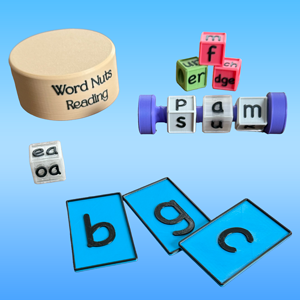
In the fall of 2024, Michael’s daughter Demi started pre-kindergarten in Los Angeles. She was a very bright kid. But that September, her DIBELS screening flagged her as in need of most support in every single category.
Her teachers were kind and well meaning, but they told Michael two things. She’ll catch up, because all kids learn at their own pace. And she’s in danger of falling behind and not moving on to kindergarten.
Michael summed it up perfectly on the show: wait and see, but also be terrified.
The school offered intervention, and Demi stayed an extra thirty minutes after dismissal. But to Michael, it looked like more of the same: more worksheets, more of what wasn’t working. When she was retested in December, there was almost no progress!
What hurt most was watching her confidence shrink. Demi was one of the oldest kids in her class and one of the furthest behind. Dyslexia also ran in the family, so Michael knew these early signals deserved more than a shrug.
Here’s what many parents don’t realize. When we think about reading, we think about letters, but reading actually starts with sounds.
Phonemic awareness is your child’s ability to hear the individual sounds inside a spoken word and play with them. Can they hear that mop is made of three sounds, /m/ /o/ /p/? Can they push those sounds back together into a word? Can they swap the /m/ for a /t/ and get top?
Not a test of intelligence, but a listening skill. And listening skills can be trained.
I like to think of it this way. Letters are the street signs, but sounds are the road itself. If your child can’t feel the road under their feet, the signs won’t make much sense. That’s why phonemic awareness activities are such a powerful starting point, especially for kids who seem stuck and struggling to learn to read.
Michael did what so many of you have done. He started losing sleep, and then he started researching. He read about Orton-Gillingham and the science of reading. He dug into Making Sense of Phonics by Isabel and Mark Beck.
But he ran into a very real problem. As a busy working dad, he didn’t have thirty minutes every evening just to plan a lesson and pick the right words. Something all of us can relate to!
Michael also happened to be a hobbyist 3D printer. He’d been printing little toys for Demi, and she loved every one of them, even the wobbly failed prints. So he wondered: could he print something that would make reading practice easier for both of them?
The answer turned out to be yes. He built a tactile, color-coded set of letter pieces that work on a bolt. Demi could touch them, turn them, and build real and nonsense words with her hands. It wasn’t an app or a screen. And it chose the words for him, so he could sit down and start practicing right away.
What Michael didn’t realize at first was that he had built something multisensory which is a cornerstone of Orton-Gillingham. When a child hears a sound, says it, sees it, and touches it all at once, the learning has more than one road into the brain. The best phonemic awareness activities work the same way.
By the end of pre-kindergarten (it’s called transitional kindergarten in CA) Michael felt confident in what he’d built. Over the summer, he and Demi practiced four or five times a week for five to ten minutes. Even when summer schedules and birthday parties got in the way sometimes, they kept going
Then came her kindergarten DIBELS screening in the fall.
Demi had gone from about 35 points below benchmark at the end of transitional kindergarten to 65 points above benchmark at the start of kindergarten. She scored above benchmark in every category.
That’s remarkable, because most kids lose ground over the summer. Demi did the opposite.
Today she’s in first grade and reading well above grade level, according to her dad. More importantly, she likes school. She feels good about reading. As a dad, Michael called it an exquisite moment.
When I asked Michael for his best advice for parents, he didn’t tell the audience to buy his product. He said to find something that works for you and your child, whether that’s a tool like his or a handful of phonemic awareness activities at the kitchen table, and then use it consistently.
If you’d like to see the system he built for Demi, visit WordNutsReading.com. Michael is launching a Kickstarter campaign on November 15 that runs through early December, with an early bird discount for backers. Word Nuts will be available on his website after December 10.
You don’t need special equipment to start phonemic awareness activities although you can find Word Nuts Reading and the phonemic awareness activities device on his website. Detailed below are five phonemic awareness activities you can do at the kitchen table, in the car, or while dinner is in the oven. Practice each one a few minutes, and stop while your child is still having fun.
If your child’s screener came back and panic has set in, please know that it’s never too late for your child to become a stronger reader. A few minutes of phonemic awareness activities each day is a wonderful place to begin. Five minutes. A few sounds. A little laughter. That’s how it starts.
If you’re unsure where your child’s gaps are, let’s figure it out together. Book a free 15-minute consultation and you’ll walk away knowing where to start.
And if you know another parent who just got that wait and see pep talk, please share this post with them.
They’re short listening games that help children hear, separate, blend, and change the individual sounds in spoken words. Most need no materials at all, which makes them easy to fit into a busy day.
Phonemic awareness is all about sounds. Phonics connects those sounds to letters. Children need both, and a strong ear for sounds makes phonics much easier to learn.
Short and consistent beats long and occasional. Five to ten minutes, four or five days a week, is a realistic goal for most families.
Not necessarily. A screener is a flashlight, not a final verdict. It shows you where to focus. Start with daily sound practice, and if progress stalls, talk with a structured literacy specialist.
I’m a visual learner but you’re an auditory learner. I’ve said that for years about my daughter and myself. It felt like an answer to how we learn. However, it’s misleading. This post explores why the 3 learning styles can be misleading and why multimodal learning is the better term.

A working memory deficit isn’t a focus problem, and the kids who have one are often paying more attention than anyone in the room. They simply run out of space. This post explains what is working memory, why it can fill up so fast and what the appropriate accommodations are.

We value common sense. There are cookies on our site and you consent to the usage.
Manage your preferences:
Essential cookies enable basic functions and are necessary for the website.
Statistics cookies collect information anonymously to understand our website.
SourceBuster is used by WooCommerce for order attribution based on user source.
For exciting reading check out our cookie and privacy policy.